For many Americans, the holiday season wouldn’t feel complete without a viewing of White Christmas. First released in 1954, the film has become a perennial favorite. At the Bruce Springsteen Archives & Center for American Music (BSACAM), we’re always interested in how moments like these—familiar, comforting, and often shared across generations—help tell the larger story of America through music. It’s why we included Bing Crosby’s contract for the film in our “Music America” traveling exhibit. Read on for a bit more about both the movie, and “Music America.”
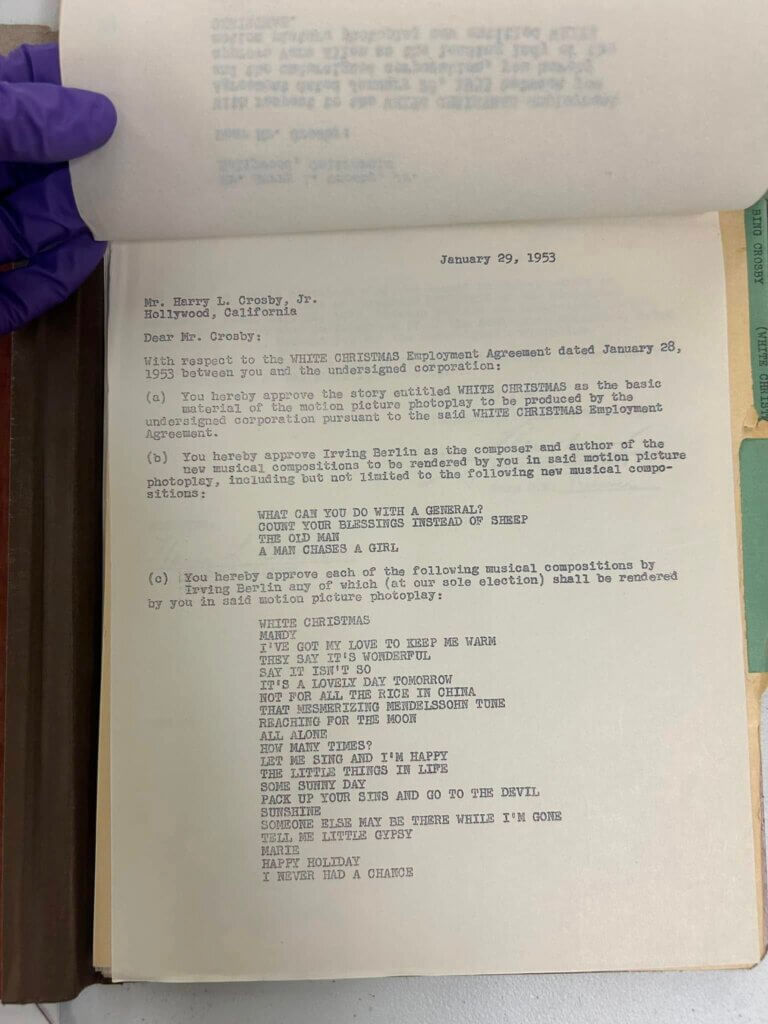
Courtesy BSACAM
The Film
Crosby was already one of the most popular entertainers in American history by the time the movie was made. His recording of Irving Berlin’s “White Christmas,” first introduced in the 1942 film Holiday Inn, had already become the best-selling single of all time. By the 1950s, Crosby’s voice was inseparable from the sound of mid-century America, broadcast into living rooms via radio, records, and, increasingly, television and film.
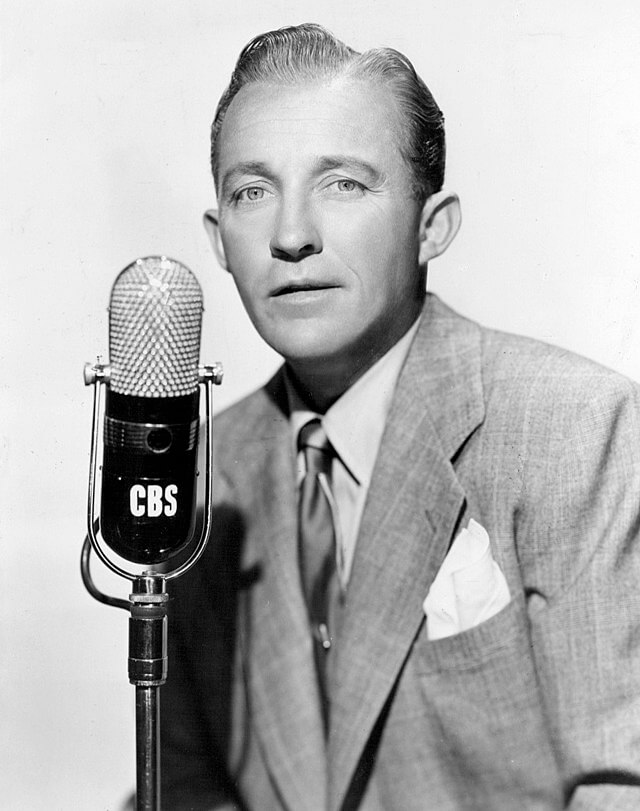
Bing Crosby, courtesy Wikimedia
The movie itself arrived at a moment of transition. It was Paramount Pictures’ first film shot entirely in VistaVision, a new widescreen format designed to lure audiences back to theaters in the age of television. (Sidenote: imagine when the movie industry only had to compete with television for viewers’ eyes, and not also the Internet!)
The White Christmas plot—about former World War II army buddies who find success in show business and reunite to save their old commanding officer’s struggling Vermont inn—blends postwar nostalgia, patriotism, and entertainment. Music drives the narrative, from lavish dance numbers to intimate vocal performances, reflecting how central song and performance were to American identity in the mid-20th century.
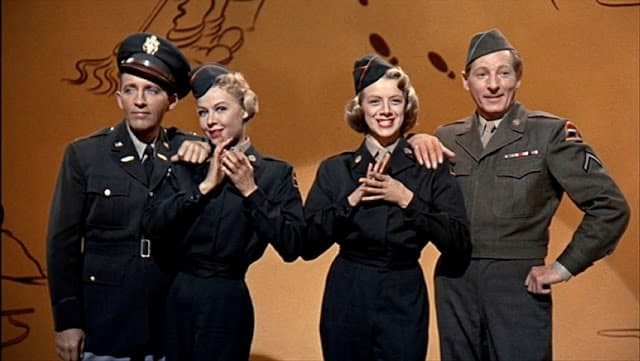
Bing Crosby, Vera Ellen, Rosemary Clooney, and Danny Kaye in White Christmas
At first glance, Crosby’s White Christmas contract may seem like a boring piece of Hollywood paperwork. But documents like this reveal how American music history is also a history of labor, industry, and mass culture. Contracts tell us who held power, how artists were valued, and how music moved from individual creativity into large-scale cultural production.
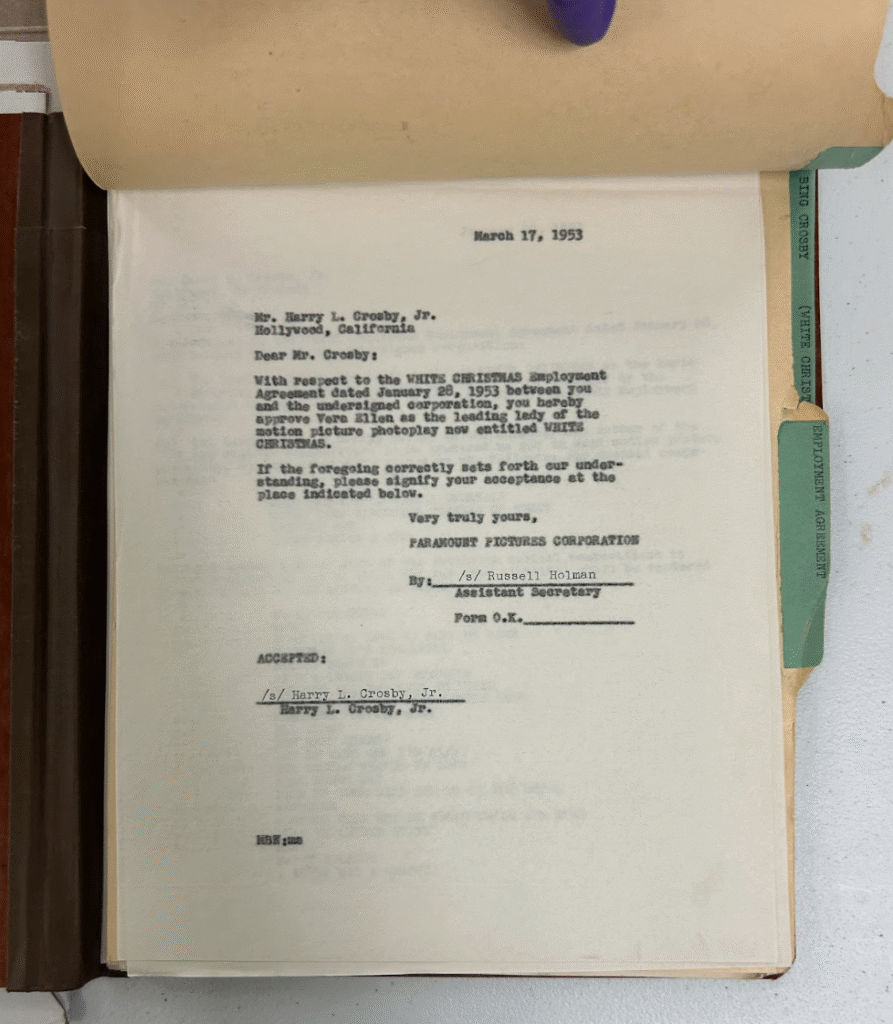
Courtesy BSACAM
More than seven decades after its release, White Christmas remains one of the most successful and enduring holiday films in American history. It was the highest-grossing film of 1954, and its popularity has only grown over time through repeated theatrical re-releases, television broadcasts, home video, and streaming. The title song has continued to top “greatest holiday song” lists, and the film itself has become a seasonal ritual for generations of viewers. Its longevity speaks not only to the appeal of its stars and music, but to its ability to capture a particular moment of postwar optimism and nostalgia—one that audiences continue to return to year after year, cementing White Christmas as both entertainment and shared cultural memory.
Speaking of memory—some of my favorite memories of the film actually have nothing to do with Christmas. Year-round, it was a habit to pick up my two boys and dance around the kitchen singing “The Best Things Happen While You’re Dancing.” Now, they’re 14 and 17, and each a good six inches taller than me. The time for picking them up has gone. But our dances are just one example of how music has a unique way of anchoring wonderful family memories that connect generations long after the moment has passed.

The Exhibit
“Music America” celebrates 250 years of American history through music, using more than 100 artifacts from the BSACAM’s permanent collection alongside items on loan from institutions such as the New Orleans Jazz Museum, Hard Rock International, and the Rock & Roll Hall of Fame, as well as private collectors from across the country. Together, these objects trace how music has reflected—and shaped—American life, from folk traditions and jazz to rock, to hip-hop, and yes, even film.
The exhibition debuted at the Lyndon B. Johnson Presidential Library and Museum in February 2024 and traveled to the GRAMMY Museum in September of that year. In April of 2025, it returned to Texas, this time to the George H. W. Bush Presidential Library and Museum. I’ll be heading to Texas in January to de-install it and move it to the Folk American Roots Hall of Fame in Boston.
In addition to Crosby’s White Christmas contract, “Music America” features a wide-ranging selection of rotating iconic objects that together tell the story of American music across genres and centuries. Highlights include instruments like B.B. King’s guitar “Lucille,” Stevie Ray Vaughan’s “Number One” guitar, and a saxophone associated with John Coltrane; typed and handwritten lyrics by artists from Woody Guthrie to Chuck D; and costumes worn by Elvis Presley, Billie Holiday, Madonna, Prince, Gloria Estefan, Taylor Swift, and Bruce Springsteen.
Learn more about “Music America” and its upcoming tour stops at https://springsteenarchives.org/.
Melissa Ziobro
Director of Curatorial Affairs
Bruce Springsteen Archives & Center for American Music
Monmouth University
December 22, 2025