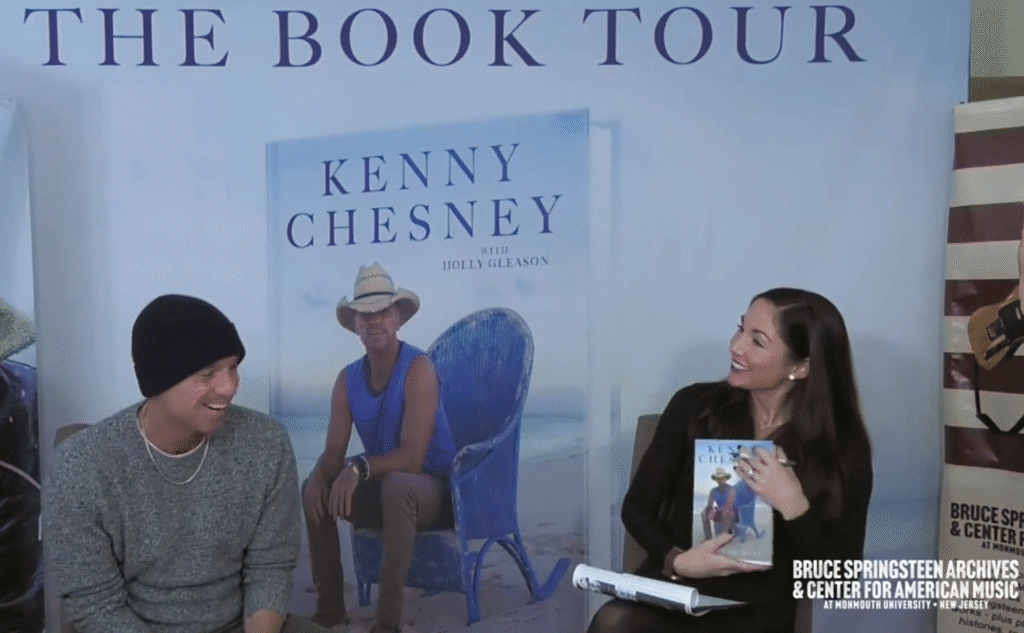
On Wednesday, December 3, Country Music Hall of Fame inductee—and now No. 1 New York Times best-selling author—Kenny Chesney visited the Bruce Springsteen Archives & Center for American Music (BSACAM) at Monmouth University for an hour-long interview and tour of our new home, currently under construction and set to open in late spring 2026.
Catch the full interview at https://springsteenarchives.org/.
So how did Kenny wind up visiting the Jersey Shore?
Because we are, after all, the Bruce Springsteen Archives & Center for American Music, I wrote about his chart-topping debut book, Heart Life Music, here on the blog on November 17. As I noted in that post, I’ve been to several of his shows, and declared that his high energy live performances would impress legendary showman Bruce Springsteen himself.
Bruce is referenced several times in the beautifully written book, to include, but not limited to, discussions of Kenny’s cover of “One Step Up” and several meaningful interactions between the two artists over the years.
I closed the blog by writing, in jest, “Now, if we can just get Kenny to join me and talk about the book on a future session of ‘Conversations with our Curator!’” I truly never imagined this would come to fruition.
“Conversations” is a free, virtual program in which I interview authors with new books on some aspect of American music history. It’s a way for us at the BSACAM to provide some additional, accessible educational content, especially for folks who can’t make it to the Jersey Shore for our various events. We have had a couple dozen truly wonderful, renowned writers on to date, to include Warren Zanes, Holly George-Warren, Nick Corasaniti, and Alan Light.
The no frills program is usually run simply via Zoom. I open with some announcements on behalf of the BSACAM, then begin my questions. I generally reserve time at the end for audience Q&A—often my favorite part, as our thoughtful attendees never fail to have wonderful questions of their own. We record the sessions, and they’re all available for playback on demand.
Back to Kenny—shortly after my blog about Heart Life Music went live, Kenny’s co-author (and longtime friend) Holly Gleason reached out to say he would, indeed, like to be interviewed. I must confess that for some reason, I initially thought this was a prank! Because, as I noted, I mentioned Kenny coming on “Conversations” in jest. His book tour has included stops on Anderson Cooper 360, TODAY, CBS Sunday Morning, and The Howard Stern Show. He’s been on the cover of Newsweek. He’s been just a little busy.
And yet—he really did want to visit us.
While we at the BSACAM are certainly not unfamiliar with high profile visitors (we’ve welcomed artists such as Darlene Love, John Mellencamp, Jackson Browne, John Fogerty, and Tom Morello to campus for American Music Honors, for example), their arrival is usually the end result of months of careful planning and coordination.
We pulled this together in a matter of days. Holly and the rest of the team could not have been more gracious or easier to work with. As I noted, “Conversations” is usually hosted via Zoom, for a number of reasons. Because Kenny would potentially be coming in person, on his way home from events in New York City, we offered any number of options—did he want us to come to him? Would that be easier? Did he want us to find a formal studio setting? Did he prefer to do it before a live audience and sign and sell books? Actually, he did not want any of these things—he wanted to visit as quietly and with as little muss and fuss as possible (which I think speaks absolute volumes about him as a person).
We wound up conducting the interview with Kenny in a University-owned house just off campus, which afforded us maximum privacy and is just a minute’s drive from our new building—which Chesney, despite a tight schedule, wanted to tour if time allowed.
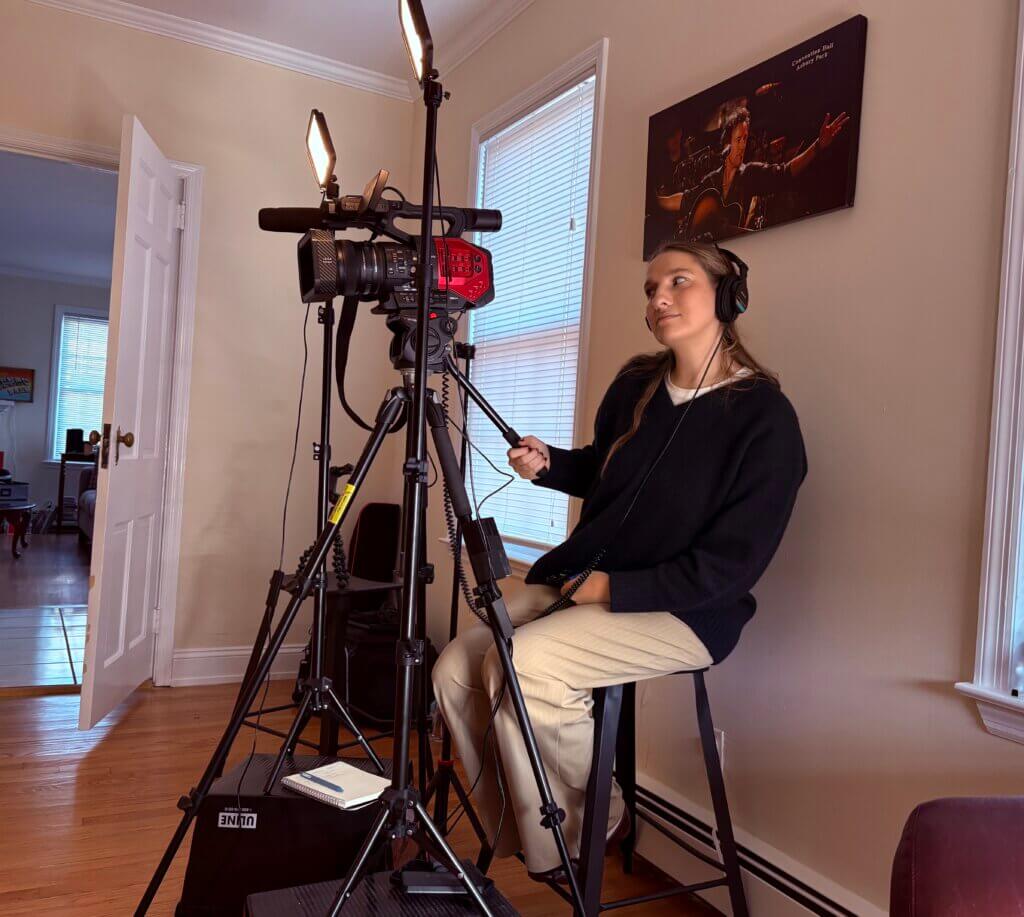
Our Operations Manager, Annalaan LeMay, behind the camera.
Here are some of my favorite moments from the interview:
On still getting a bit anxious before shows because of the level of commitment he has to his fans:
“… I don’t get scared, I don’t get nervous that I’m going to forget the words…And I don’t get nervous that something is going to happen, because usually something does…and you roll with it. I just get anxious about the connection…
You know, I’m a human being. So sometimes…there’s been times I’ve been on the phone, you know, going through something with a family member or a girlfriend or whatever, and it’s not the right time to go on stage. But you’ve got to. And…I just get anxious about being— I want to be present and…I don’t want to miss the moment, honestly, because I think about me. I think about me going to shows when I was a kid, and I think about us being up there, having this moment, and there’s a kid in the audience that has never been to a live show in his life, and if we don’t do our job, then we’ve missed the chance to touch that child, to inject music and life into him. Right now, if we do our job, maybe that child will have music in his life for the rest of his life. I think about those kinds of things before I go on stage. That’s what I get anxious about.
It’s a very…powerful position to be in. It really is. And I’m thankful for it, but—those are the things that I think about a lot and get anxious about.”
On labels in the music industry:
“I’m a country artist because of how I talk…but melodically, my brain goes to a lot of places. Right? I’ve been fortunate enough to collaborate with a lot of people that you know, on the surface, it may not seem…that I should be collaborating with them, but you put me and Grace Potter in a room together into a studio, and somehow it works. And you put me and Ziggy Marley in a studio together, and somehow it works. Culturally, we’re very different—but it works. You put me and Dave Matthews in a room together, and somehow it works. [In that case,] I’m just an artist.”
On Bruce Springsteen as an inspiration:
“I was playing in Holmdel, New Jersey, and I get a call from Louis Messina, who’s my concert promoter who’d worked with Bruce a lot, and he said, ‘Bruce Springsteen’s going to come see your show tonight.’ And I couldn’t believe it.
And all of a sudden…we hear a knock on the front door and I look out, I’m like, ‘damn, that’s really Bruce Springsteen out there!’ Right?! But Bruce came up and we chatted a little bit before the show, and then I went out to do the show, and then Bruce came back on the bus and we sat there and talked, almost for two hours…
I think he saw something in me that he recognized because I was pretty tired and exhausted, and…was just coming to terms with…any sort of celebrity, and any sort of, my life changing. And we talked a long time about that, but it was like—yeah, it was very magical.
You know, to have someone that I really—there was such a reverence for him and his journey and him as a creative person—to acknowledge that I was, you know, going through some of the same things that he went through at all, and to give me some sort of advice like that, I’ll never forget it.”
After hearing Kenny reflect so thoughtfully on his life, work, and influences, we were thrilled that there was still just enough time left to bring him to the place where we’ll soon be celebrating these American music history stories—like Bruce’s, Kenny’s, and so many others. So we headed over to the site of our new building, where we showed Kenny and his lovely team the soundstage, and walked them through how the galleries will explore not only Bruce Springsteen and the E Street Band, but American music history more broadly.
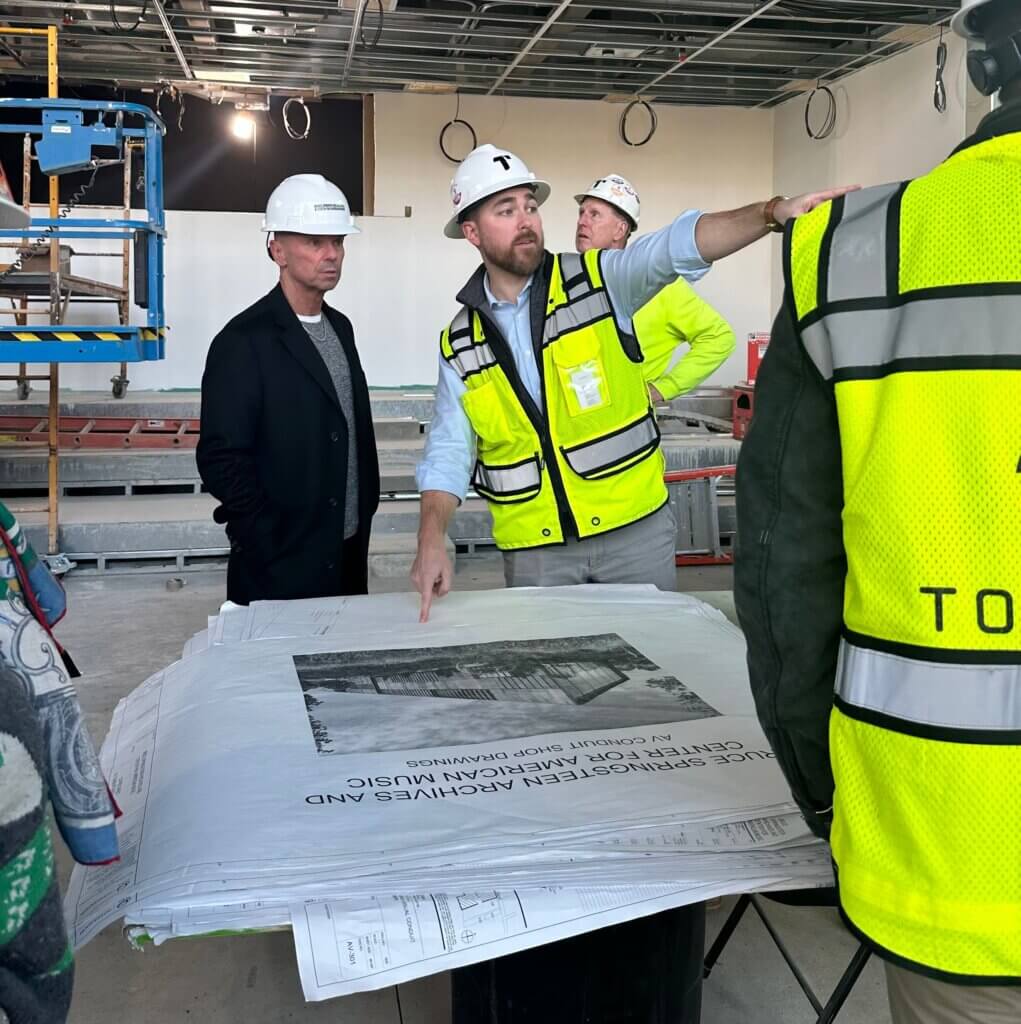
Kenny listens as Tim Blake of Torcon describes elements of our new Center.
In Conclusion…
I often tell people that I want “Conversations” to feel not like they’re in class with me, but like we’re just hanging out in our living room chatting about great reads. I am so grateful that Kenny was down to come hang in our actual living room and chat about his great read.
We often try to divide music into tidy boxes: country here, rock over there, Jersey Shore on one shelf and Nashville on another. But the artists themselves have never lived that way. Bruce drew from folk and gospel; Kenny grew up on country, then in college became more exposed to rock. Both have spent careers honoring the musicians who came before them. Whether it’s country, rock, folk, soul, or anything in between, our mission at the BSACAM is to document how artists learn from—and inspire—one another, and us.
That’s the heartbeat of what we do at the Archives. We’re here to capture those overlaps, those surprises, those moments when two seemingly different musical worlds suddenly feel like one shared conversation that both document our American life, and uplift, inspire, and motivate us. Kenny’s visit was an unexpected gift—and a perfect reminder of why this work matters.
Oh and PS—don’t forget—grab a copy of Heart Life Music wherever you get your books!
Melissa Ziobro
Director of Curatorial Affairs
Bruce Springsteen Archives & Center for American Music
Monmouth University
December 10, 2025