I was giving a public program on music and the Vietnam War last month, and a veteran in the audience approached me at the end and asked why I didn’t include Bob Hope’s Christmas shows. He’d been to one during his tour of duty, and it had a profound impact on him. It was something I simply excluded in the interest of time, but the holiday season provides the perfect opportunity to revisit the topic.
For decades, American entertainer Bob Hope (1903 – 2003) was synonymous with the holidays for American troops overseas. While families gathered around trees and tables back home, Hope and his troupe traveled thousands of miles to bring a sense of familiarity—and laughter—to men and women serving far from home. His Christmas shows were not just entertainment; they were carefully timed morale boosters, arriving at the loneliest moment of the year for deployed soldiers. Nowhere did that tradition feel more urgent, or more complicated, than during the Vietnam War.
By the time Hope arrived in Vietnam in the 1960s, he was already a veteran of wartime performance, having entertained US forces during World War II and the Korean War. But Vietnam presented a very different environment. The war dragged on without clear resolution, public opinion at home was increasingly divided, and many troops felt disconnected from the country they were serving. In this context, Hope’s holiday tours offered a brief escape—an evening of jokes, music, and celebrity appearances that reminded soldiers of home, normalcy, and shared culture.
The shows themselves were elaborate productions, featuring comedians, singers, dancers, and Hollywood stars who braved difficult conditions to perform on makeshift stages, airfields, and military bases. Hope’s humor often leaned on topical references and gentle patriotism, acknowledging the hardship of service while affirming the troops’ presence and sacrifice. For soldiers in Vietnam, these performances were moments of collective release—laughter cutting through tension, music filling spaces otherwise shaped by uncertainty and danger.
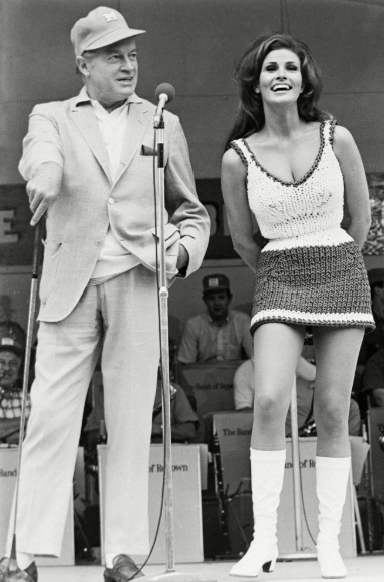
Bob Hope and actress/singer Raquel Welch share the stage as they entertain the troops in Vietnam, 1967. Courtesy AP/Shutterstock/VVMF.org.
Yet Hope’s Vietnam tours also reflected the growing complexity of the war. As opposition intensified back in the United States, his unwavering support for the troops—and for the mission—made him something of a polarizing figure. Even so, for many service members on the ground, the arrival of Bob Hope at Christmas remained a powerful symbol: someone had not forgotten them. In a war defined by ambiguity, his holiday shows offered something simple and deeply human—the chance, if only briefly, to feel seen, supported, and connected to home.
Don’t take my word for it—I always say history is best told in the words of those who lived it.
Brian Allen is one of the veterans whose stories are included in my recent book, The Battlin’ Bastards of Bravo: Bravo Company, 1/506th, 101st Airborne, in Vietnam and Beyond. As he recalls, he was willing to tell a little fib to score a seat at one of these legendary shows:
“…a few days before Christmas 1970, we went to a small hilltop named LP [listening post] Longshot in a fairly quiet area. We renamed the hill FB [firebase] Noel. I was the company radio telephone operator, and I got a call from the rear to get five guys ready, as a chopper is coming to take them to the Bob Hope Christmas Show. I go to my captain—I can’t remember his name because the leadership was changing quite often as the war was winding down, and every rear-duty officer was trying to get his records to show he led an infantry unit in the field for a while. But I tell the captain we need to get four guys and me ready for the chopper. I don’t know if he knew I was lying or not, but we picked four guys and off we went when the chopper came. We were fairly filthy, we’d been out for a few weeks, and we took our weapons with us. That may or may not be why we got such good seats! We picked them out ourselves, right behind Vietnam’s Vice Air Marshal Nguyen Cao Ky, and no one complained. While clearing our weapons, some clown chambered a round in his .45 and then dropped the magazine and pulled the trigger. Blam! It hit the asphalt by my feet and sent a piece of it to the corner of my eye. Unbelievably, this was the second time this had happened to me! So anyway, Bob comes out to start the show, and a gunship a couple clicks outside the wire opens up with his minigun which sounds like a buzz saw and sends a solid line of tracers into the ground. I realize that this probably happens at every show, with the gunship boys trying to impress Bob. It’s a great show: Bob, [Major League Baseball player] Johnny Bench, [singer, dancer, and actress] Lola Falana, and others. We leave right after the show, and back to FB Noel we go.”
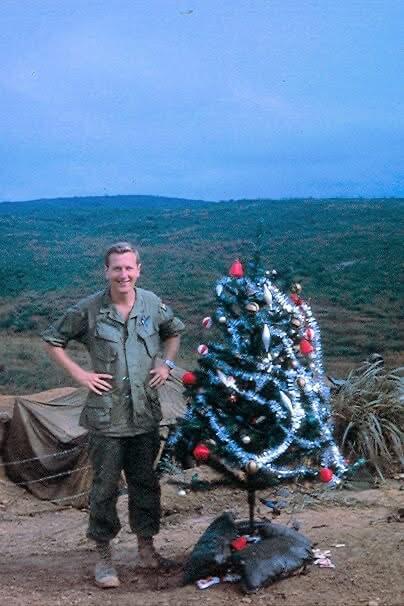
Didn’t score a ticket to see Bob Hope? Try a Christmas tree! Bravo Company commander Lee “Baron” Sullivan keeps the holiday spirit alive in Vietnam, 1969. Courtesy Mike Bookser.
Another “Battlin’ Bastard,” Danny McNair, shared:
“I was a Sgt. E-5 in December 1970 and was selected from the 3rd Brigade to travel from Camp Evans where Bravo was located to Camp Eagle where the 3rd Brigade Headquarters was located. I was assigned to stay close to Bob Hope as security for him. He brought Lola Falana, Johnny Bench, and [female singing and dancing troupe] the Golddiggers with him for the 101st Airborne Show. The group who accompanied Hope, you could easily see held him in very high regard, as almost a hero for what he sacrificed to be with the troops. He was like a mentor to those with him. The troops also held him in that same high regard. Hope was readily accessible and seemingly at ease enjoying what he was doing. He was truly a patriot of the highest order, putting himself before those he came to entertain and bring some of the feeling of being back in the USA with him. I can’t say enough about the impression he made on all of us. It was like he was drawn to serve others year after year because it was so important and he made it a priority.”
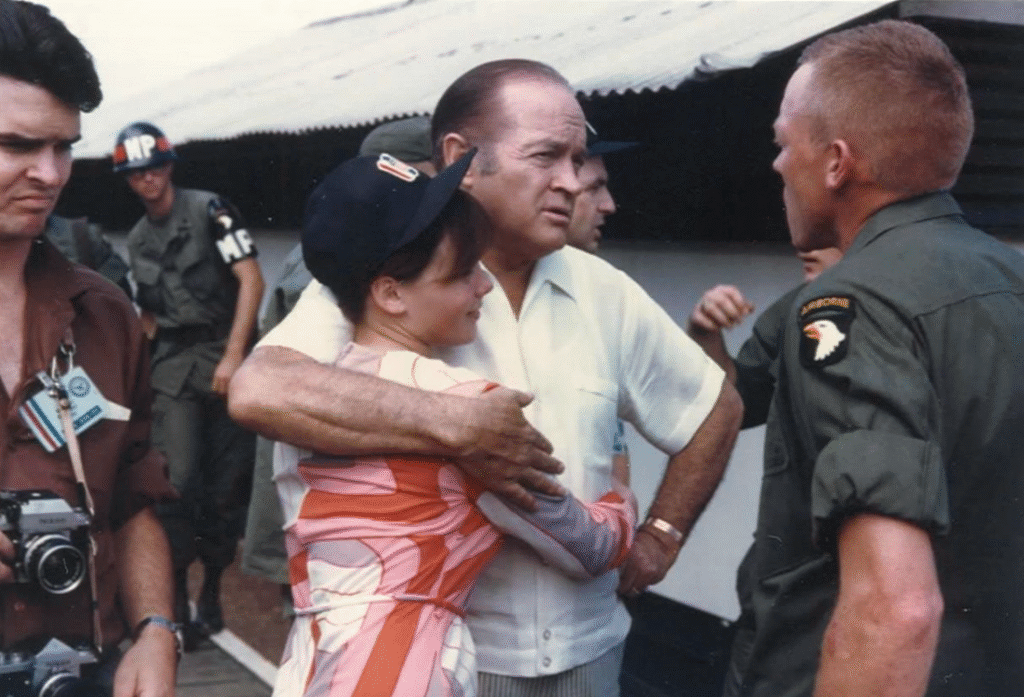
Bob Hope talking to Medal of Honor winner Joe Hooper, December 1970. Courtesy Danny McNair.
Taken together, these recollections help explain why Bob Hope’s Christmas shows endure in the memories of those who served. Beyond the jokes, celebrity cameos, or spectacle, they offered something far more essential: a shared pause in the middle of a relentless war, a reminder of home, and a sense that the sacrifices being made were recognized. In Vietnam—a conflict marked by uncertainty and division—music and entertainment became a form of emotional sustenance, briefly restoring connection, humanity, and hope.
Melissa Ziobro
Director of Curatorial Affairs
Bruce Springsteen Archives & Center for American Music
Monmouth University
December 30, 2025