The Grand Ole Opry celebrated its 100th anniversary with a star-studded event on November 28th, and we’re using that occasion as an opportunity to celebrate the Opry’s legacy and impact, and recall a time Bruce Springsteen graced its hallowed halls.
The History
The Grand Ole Opry’s 100th anniversary marks a century of shaping the sound, identity, and mythology of American music. Since its first radio broadcast in 1925 as the WSM Barn Dance, the Opry has served as both a proving ground and a sacred stage—launching careers, preserving traditions, and bringing the voices of country, bluegrass, gospel, and American roots music into living rooms nationwide. Its longevity is not just a testament to the artists who have stood beneath its lights but to the communities of fans who have treated Saturday night at the Opry as a cultural ritual. As it reaches its centennial, the Opry stands as a living institution—one that continues to honor its past while championing the next generation of musicians who carry the story of American music forward. Read more about the Opry’s storied history here.
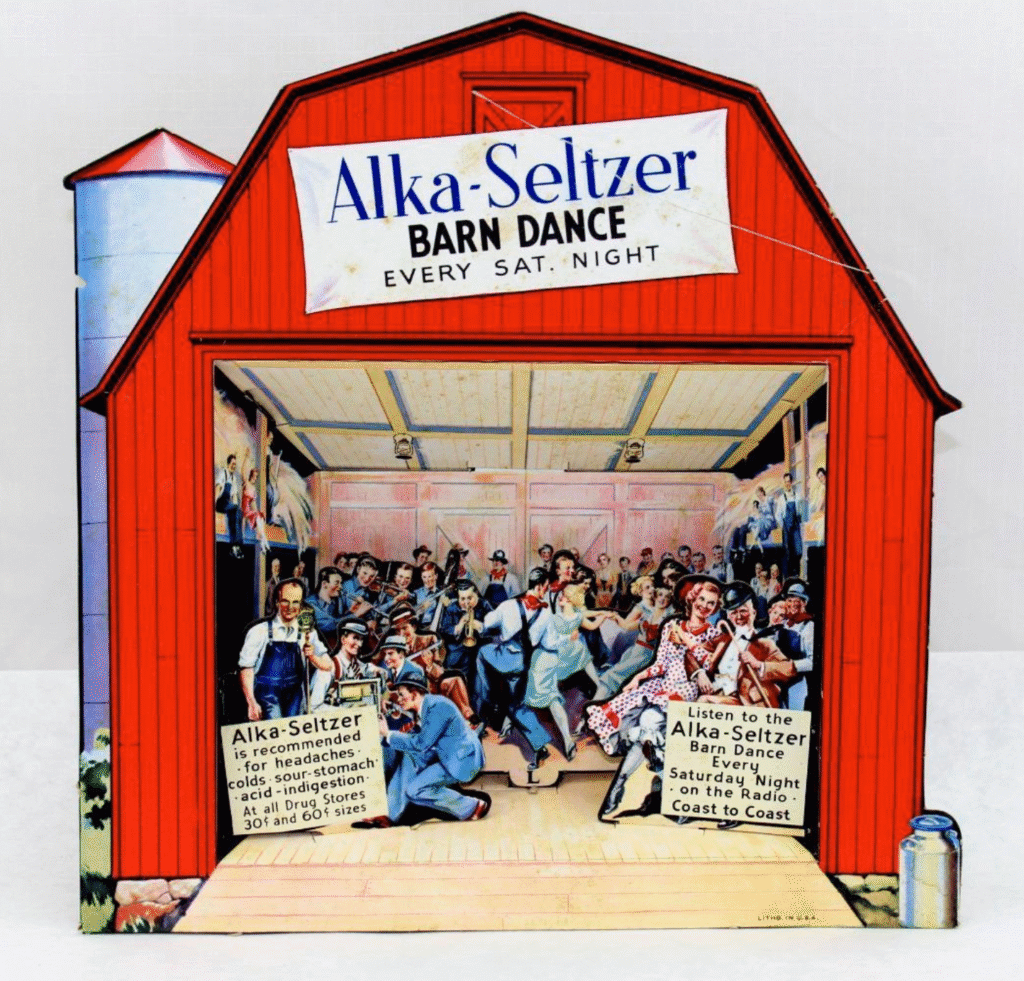
We at the Bruce Springsteen Archives & Center for American Music (BSACAM) mark the history of the Grand Ole Opry in our “Music America” traveling exhibit with select items like this rare 3D promotional prop. “Music America” opened at the Lyndon B. Johnson Presidential Library and Museum in Austin Texas, in February 2024 before moving to the GRAMMY Museum in Cleveland, Mississippi. The exhibit is currently at the George H. W. Bush Presidential Library and Museum in College Station, Texas, and will move to the Folk Americana Roots Hall of Fame in Boston this winter.
Springsteen Plays the Opry
At first glance, few worlds seem farther apart than the Jersey Shore rock scene and the storied institution of Nashville’s Grand Ole Opry. One is built on boardwalk grit and bar-band energy, while the other is the heart of country music tradition—a place where heritage, storytelling, and a century of performances have shaped the sound of the American South.
But on April 28, 1976, these two musical geographies briefly intersected. Bruce Springsteen and the E Street Band took the stage at the Grand Ole Opry House, delivering a full-tilt rock-and-roll show in a venue where fiddles, steel guitars, and country harmony usually reign. It remains one of the very few times in the Opry’s history that a rock artist was invited to headline there.
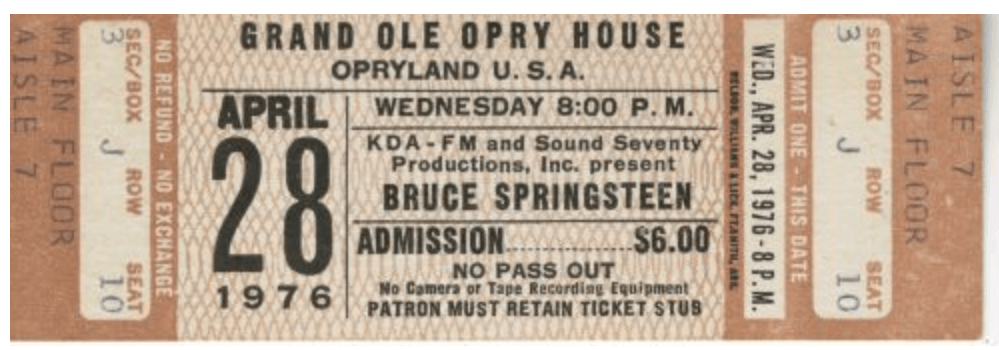
Courtesy Brucebase.com
Springsteen was in the thick of the Born to Run era—young, energetic, and redefining what American rock could look like onstage. For Nashville audiences, his arrival wasn’t just a novelty; it was a reminder of how fluid the boundaries between musical genres really are. Country and rock share common ancestors in blues, folk, gospel, and the stories of ordinary Americans. Springsteen’s songwriting—steeped in working-class life, heartache, aspiration, and geographic identity—is, in many ways, a cousin to the narrative traditions long upheld at the Opry.
The performance also underscores a larger truth about American music: crossroads moments matter. When a Jersey Shore rocker performs in the home of country music, it reminds us that genres aren’t silos—they’re conversations. Artists borrow, bend, and reinterpret traditions across state lines and stylistic borders.
For the BSACAM, moments like this are essential to understanding not just Springsteen’s career, but the broader landscape of American musical heritage. The Archives explore the interconnectedness of regional scenes, cultural histories, and artistic lineages—and the 1976 Opry performance is a perfect example of such cross-pollination.
Springsteen didn’t become a country artist after that night, nor did the Opry suddenly shift its identity. But that brief meeting—Jersey grit on a Nashville stage—is a reminder that American music remains a living, blending, boundary-crossing force. And sometimes, its most interesting stories happen in the spaces where you least expect the worlds to collide.
Post-script
Did you know? In 2023, we at the BSACAM honored singer-songwriter Steve Earle in our first cohort of American Music Honors recipients—and in September 2025, Steve was officially inducted as a member of the Grand Ole Opry, becoming the first artist to join during the Opry’s 100th anniversary year.
2025 American Music Honors awardee Emmylou Harris has been an Opry member since January 25, 1992.
Melissa Ziobro
Director of Curatorial Affairs
Bruce Springsteen Archives & Center for American Music
Monmouth University
November 30, 2025